Combi vs Condensing Boiler: What Is the Difference?
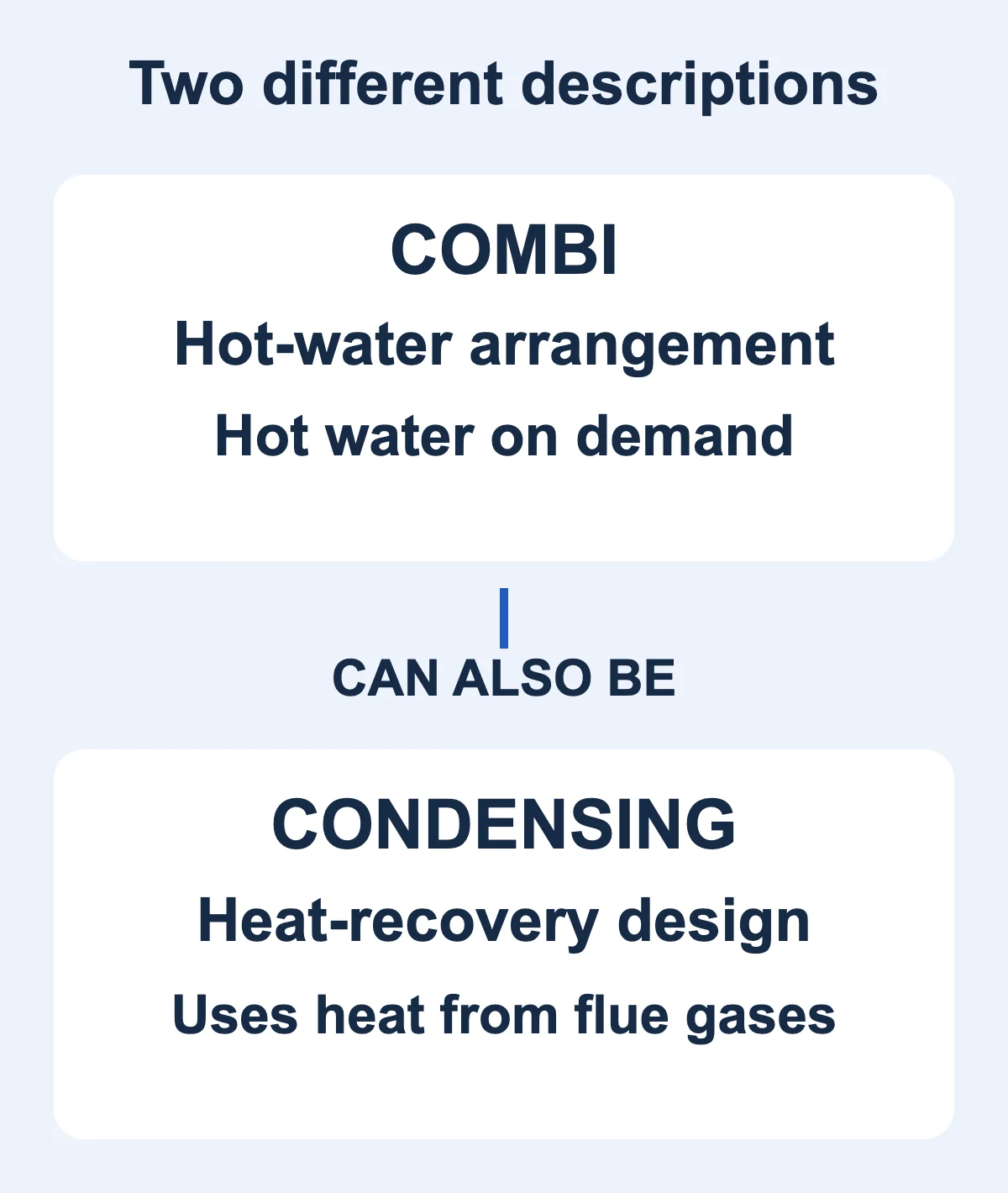
A boiler can be both combi and condensing. “Combi” describes how it provides household hot water: on demand, normally without a separate hot-water cylinder. “Condensing” describes how it recovers heat from combustion gases. They answer different questions, so they are not competing boiler types.
By Plumber Leicester Pro editorial team · Checked . General guidance; use your appliance instructions for your model.
In this guide
What does combi mean?
A combination boiler supplies central heating and heats domestic hot water as it is needed. Its heating water and the water delivered to your taps are separate circuits. In a typical combi installation, you do not need a separate hot-water storage cylinder. Worcester Bosch’s boiler-type guide explains the main arrangements.
The practical questions are how much hot water the home needs at once and whether the incoming water supply can support it. Tell the installer about simultaneous showers, baths and any planned extension. The number of bedrooms alone cannot answer those questions.
What does condensing mean?
A condensing boiler is designed to recover additional heat from the gases produced when fuel burns. Cooling those gases sufficiently causes water vapour to condense, releasing heat that can be used in the heating system. The resulting condensate leaves through its designed drain route. Heat-exchanger layouts differ between models; there is no universal second-exchanger arrangement to identify by looking inside.
Worcester Bosch explains how operating conditions affect condensing. Your installer should set up the heating and compatible controls for the property. Do not open the boiler or adjust gas components. Do not copy a flow-temperature setting without considering the system, comfort requirements and any hot-water cylinder.
How combi, system and regular boilers compare
| Description | What it tells you | What it does not tell you |
|---|---|---|
| Combi | Domestic hot water is normally heated on demand without a separate cylinder. | Whether the mains supply and output meet your simultaneous demand. |
| System | The boiler commonly works with a separate hot-water cylinder. | That every cylinder or shower arrangement is compatible. |
| Regular / heat-only | A boiler used with separate system components; often an existing cylinder-based installation. | That every installation has the same tanks, controls or pipework. |
| Condensing | The boiler can recover additional heat from combustion gases. | Whether it is combi, system or regular, or the right size for your home. |
Does a cylinder contain radiator water?
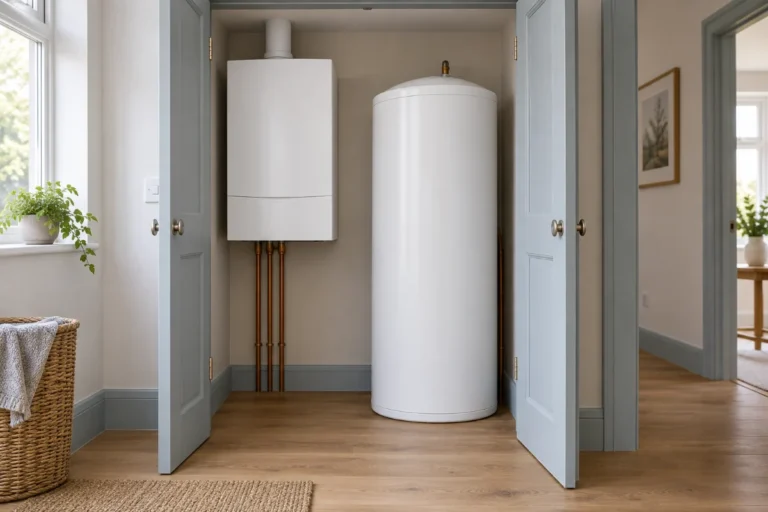
In a typical indirect hot-water cylinder, the boiler heats a coil inside the cylinder. Heat transfers through the coil into the stored domestic water. The heating water in the coil does not mix with the water supplied to taps. Other cylinder designs exist, so the installer must identify the actual arrangement.
How to identify your boiler safely
- Read the model from accessible paperwork or the visible external label.
- Look up the user manual on the manufacturer’s website.
- Tell the installer whether the home has a hot-water cylinder and any loft tanks.
- Photograph only accessible external controls and equipment; do not remove covers or climb into unsafe spaces.
A plastic drain pipe can be a clue, but the exact model documentation is the reliable way to identify the appliance. Do not confuse a condensate drain with a safety discharge pipe or change either.
Which option should you choose?
Start with a survey of heat loss, hot-water demand, supply pressure and flow, available space and existing equipment. Compare a suitable combi with a suitable cylinder-based proposal if both are practical. Our combi-versus-system guide explains the household decision in more detail.
Compare complete installed quotes, control arrangements and guarantee terms. Avoid choosing solely on a larger kilowatt number or an unsourced promise of future fuel compatibility. If you are considering a heat pump later, discuss that plan before removing useful cylinder space.
Do I need to replace a working non-condensing boiler?
Ask for a condition and repair assessment, then compare the actual replacement cost with a realistic running-cost estimate for your home. A fixed age or promised payback period does not establish the answer. See when to consider replacement and what an installed boiler quote should include.
Need help comparing boiler options?
Tell us your existing model, whether there is a cylinder, and how many bathrooms you use at the same time.
Call 0116 488 6858 Ask about a boiler survey
24/7 enquiries. The supplier confirms availability, the work and charges before you agree to a booking.